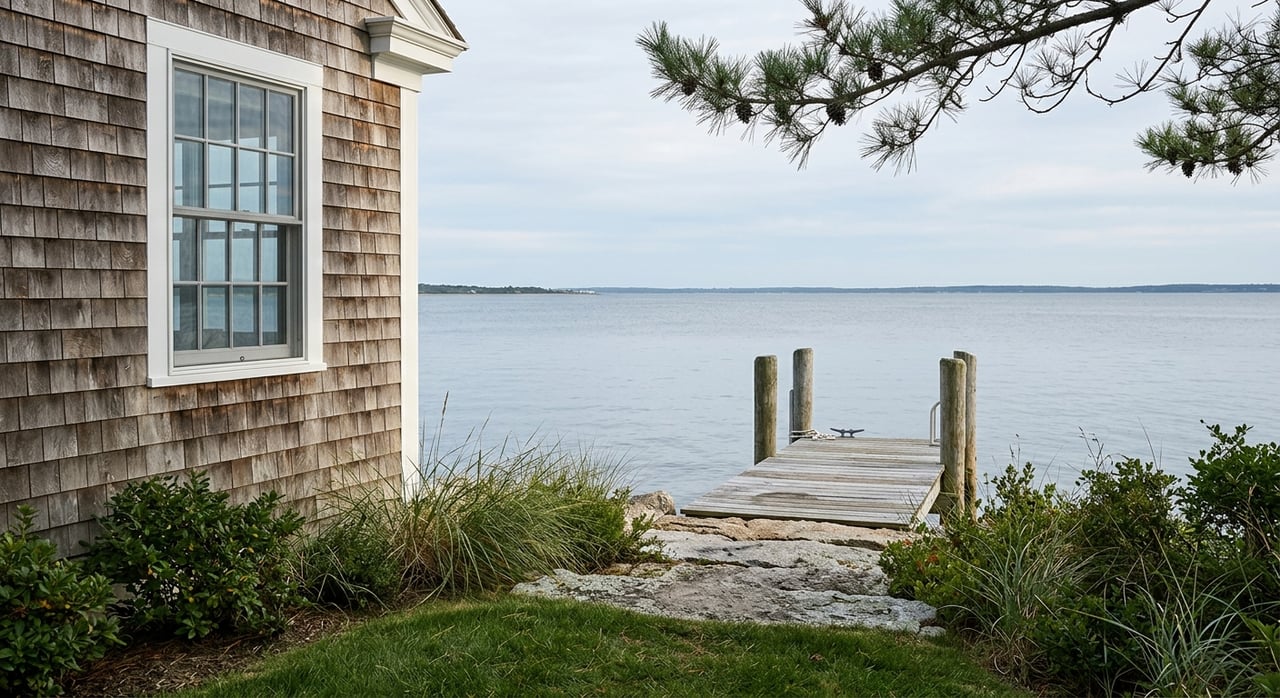
What To Know About Buying Dock-Access Homes In Boothbay Harbor
July 16, 2026
July 16, 2026
If you picture a dock-access home in Boothbay Harbor as a simple waterfront upgrade, think again. Here, the details matter because tides, permits, and harbor rules can change how useful a property really is for your boat and your lifestyle. If you are shopping for coastal property and want access to the water without surprises, this guide will help you ask the right questions before you buy. Let’s dive in.
Boothbay Harbor is a highly local waterfront market. According to the Maine Department of Marine Resources station in West Boothbay Harbor, the mean tide range is 8.8 feet and the spring tide range is 10.1 feet. That means a property that looks ideal at high tide may function very differently at low tide.
The main harbor is sheltered, but summer boat traffic is heavy. Severe storms can bring waves of 3 to 4 feet, and some coves may develop thin winter ice. For you as a buyer, that makes water depth, wake exposure, winter conditions, and seasonal usability just as important as the house itself.
Not every dock-access property offers the same kind of access. In Boothbay Harbor, a home may rely on a private dock, a float, a mooring, or seasonal use of town facilities. Those options are not interchangeable, and they are governed differently under local rules.
The town’s harbor regulations give the Harbor Master authority over mooring placement and rules related to waters, docks, floats, and piers. That is why you should never assume that a listing’s waterfront description tells the full story. You need to confirm exactly what type of access exists and whether it fits your intended use.
One of the biggest misunderstandings in waterfront purchases is the idea that a mooring automatically comes with the home. In Boothbay Harbor, mooring permits are generally not transferable. The town allows only a narrow exception for certain commercial-fishing family transfers.
That means you should treat a seller’s existing mooring as a separate issue that needs verification. If your plan depends on keeping a boat close to the property, this is one of the first questions to answer during due diligence.
Mooring permits in Boothbay Harbor must be filed through the Town Office, and each permit expires on June 30. If a renewal is incomplete or late, fees may apply. If payment has not been received by August 31, the mooring is considered abandoned.
These deadlines matter because access on paper can disappear if records are not current. When you are evaluating a property, ask for the permit status, renewal history, and any paperwork tied to the mooring location.
If you cannot take over the seller’s mooring permit, you may need to apply for one yourself. The town maintains a waiting list and gives priority in a specific order, beginning with riparian owners. After that come resident commercial fishermen, residents, nonresident commercial fishermen, and other nonresidents.
The town also charges nonresident mooring fees at double the resident rate unless the applicant pays a boat excise tax or property tax to Boothbay Harbor. If you are buying as a second-home owner or relocating from out of town, this is an important budget and timing detail.
Some buyers think they can simply anchor a boat if a mooring is not available. In Boothbay Harbor, that is not a reliable substitute. The local code says anchoring in the inner harbor requires written approval, and anchoring elsewhere is limited to two weeks without written permission.
The code also states that no mooring may be installed in a location unless it is designated by permit. In short, temporary anchoring does not solve a long-term access problem. If boat access is a must-have, confirm the legal setup before you move forward.
A waterfront structure may look charming in listing photos, but the practical details matter more. You should ask how much water depth is available at low tide, what type of boat the setup accommodates, and whether heavy summer traffic creates uncomfortable wake conditions.
You should also ask about winter use and maintenance. Thin ice, storms, and seasonal wear can affect floats, ramps, and hardware. A setup that works well for kayaks or a skiff may not work for a larger boat.
Parcel-specific rules may also limit what you can build or expand. In the shoreland area north of the footbridge, the local code says a dock, wharf, or pier may not exceed 12 feet seaward or 6 feet in width. A float or arrangement of floats may not exceed 10 by 16 feet, and a ramp may not exceed 3 feet in width or 30 feet in length.
Those limits can be a major issue if you are hoping to enlarge an existing structure later. Before you buy, compare the current setup to your boating needs instead of assuming you can modify it after closing.
If you plan to repair, expand, or build a dock-related structure, permit review is often part of the process. Boothbay Harbor’s shoreland zoning applies within 250 feet of the upland edge of a coastal wetland, including areas affected by tidal action. Permit applications must be submitted in writing and include a scaled site plan.
That local permit may not be the only one required. Maine’s Natural Resources Protection Act requires a Department of Environmental Protection permit for construction, repair, or alteration of permanent structures adjacent to coastal wetlands. The town ordinance also notes that some work over navigable waters may require Army Corps review.
Some dock-access homes in Boothbay Harbor may also fall within mapped flood hazard areas. The town participates in the National Flood Insurance Program and recognizes FEMA special flood hazard zones A, AE, and VE through the county flood maps and study.
Before construction or development begins in one of those hazard areas, a flood hazard development permit must be obtained from the Code Enforcement Officer. That permit is separate from other local approvals. If you are considering changes to the property, flood review may become part of your timeline and budget.
Flood insurance should also be part of your financing conversation early in the process. If a property is in a Special Flood Hazard Area and you are using a government-backed mortgage, flood insurance is required.
Boothbay Harbor’s flood ordinance says elevation certificates are used to verify compliance and are required for purchasing flood insurance. If the property you want is near the water, ask for available elevation and flood-related documents as early as possible.
Dock access is not just a feature. It comes with ongoing responsibilities. The permit holder is responsible for procuring, installing, and maintaining mooring hardware, and that hardware must be inspected every two years.
If a property includes a float, the town requires reflective markers, identification, and good serviceable condition. The town can also treat abandoned boats or moorings as violations and remove them at the owner’s expense. That is why maintenance records matter just as much as the scenic view.
For a dock-access purchase in Boothbay Harbor, local guidance is especially important. The most useful professionals often include the Harbor Master, the Code Enforcement Officer, a licensed surveyor or engineer, a marine dock contractor, and an insurance agent who handles coastal and flood policies.
This kind of team helps you verify what exists, what is allowed, and what future costs may look like. It also helps you avoid buying a property that sounds right in a listing but does not match your real-world boating plans.
If you are seriously considering a dock-access home in Boothbay Harbor, bring these questions into the conversation:
Buying a dock-access home in Boothbay Harbor can be a great fit if you go in with clear eyes. The right property is not just about shoreline and views. It is about legal access, physical usability, maintenance obligations, and a setup that works through the realities of Maine coastal conditions.
When you understand the permits, structures, and harbor rules upfront, you can make a better decision and avoid expensive surprises later. If you want local guidance as you compare waterfront and dock-access homes in Boothbay Harbor, Marsha DeCosta offers calm, practical support backed by deep Midcoast Maine knowledge.
Stay up to date on the latest real estate trends.
With a trusted network of industry experts—including photographers, stagers, lenders, inspectors, and title professionals—Marsha ensures every transaction is handled with precision and care from start to finish. Whether you’re buying your first home, searching for a coastal retreat, or ready to list your property, Marsha DeCosta is a REALTOR® who makes every client’s real estate experience seamless, informed, and rewarding.
Marsha DeCosta
[email protected]
(207) 380-9970
License #BR925618
152 Main Street Wiscasset ME 04578