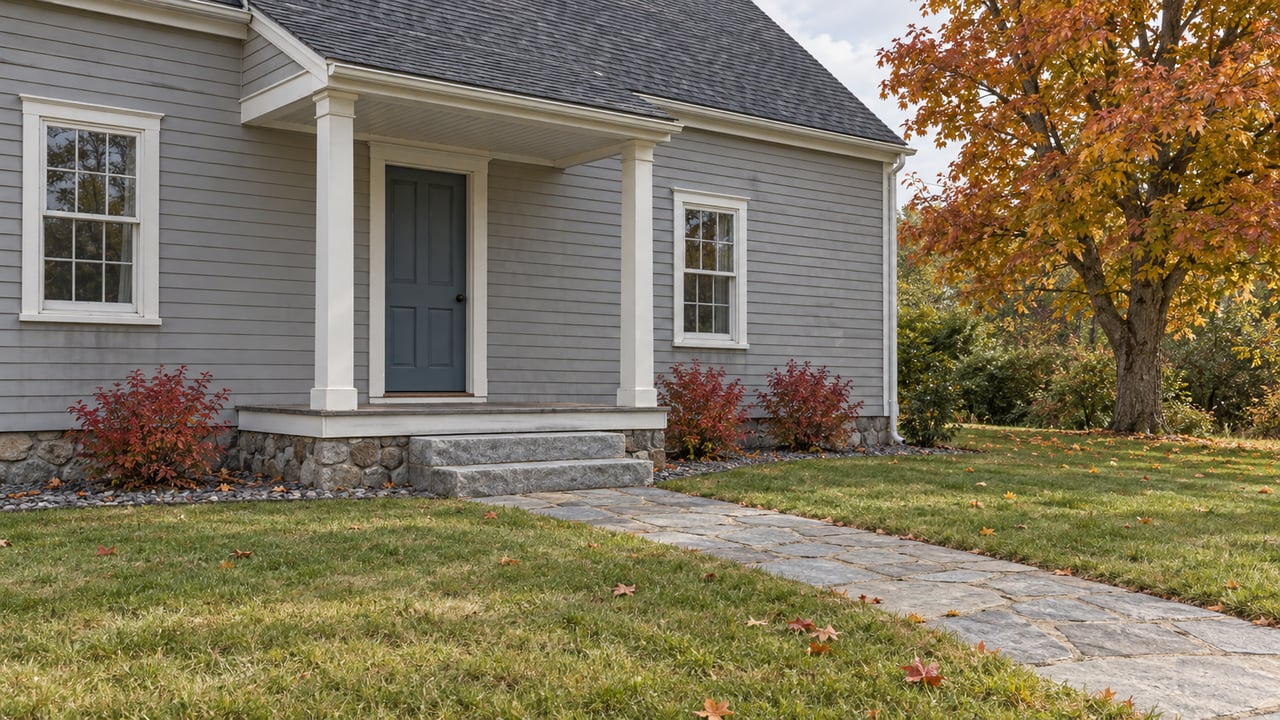
Newcastle Maine Joint Public Works Vote: What November 3 Decides
October 22, 2026
October 22, 2026
Every fall, Newcastle's Road Commissioner reposts the same request about mailboxes. Measure from the bottom of the box, not the post, down to the finished pavement, and leave at least 44 inches of clear width. The plow equipment stands about 40 inches tall, and ice on the road lifts it a little higher. The town uses the MDOT standard instead of the generic USPS guidance, and under state law a box placed beside the road sits there at the owner's risk. Read the full message on the town's plowing page.
The note says "the equipment that we use," but the town owns none of it. Newcastle has no public works staff and no trucks, and it contracts out nearly all of its road work. On November 3, voters here and in Damariscotta decide whether to change that, and the decision comes in steps. This first vote is small and easy to undo. The big decisions come later.
The two towns start from very different places. The select boards built a proposal explorer from the working group's files, and it lays the two side by side.
| Today | Damariscotta | Newcastle |
|---|---|---|
| Total centerline road miles | 26.53 | 48.64 |
| Winter plowed miles | 21.93 | 42.62 |
| Summer maintained miles | 15.58 | 24.33 |
| Sidewalk miles | 2.41 | 1.83 |
| Staff | Road Commissioner, currently the Town Manager, plus 2 FTE | Road Commissioner with no stipend, 0 FTE |
| Equipment | F550 dump, WL28 loader, 1025R, trailers, attachments | None; contracts virtually everything |
Newcastle's winter route is nearly twice as long as Damariscotta's, and it has no town staff behind it. So the proposal means something different on each side of the bridge. Damariscotta would be growing a small crew it already has. Newcastle would be getting road staff for the first time. Under the Standard plan, the shared department would have 7.5 full-time equivalents: a road commissioner, a road foreman, five full-time laborers and drivers, and half a winter seasonal position.
The select boards' joint letter to residents names the practical changes. As The Lincoln County News reported on September 17, 2026, the letter says contracted work can be limited during active snowfall, and an in-house crew would also handle preventive work like ditching, culvert clearing and tree trimming.
The money case rests on one number, which is how fast plow contracts get more expensive. The explorer calls winter plow-contract inflation "the biggest lever" in its model. It puts the historical rate at roughly 6 to 9 percent a year and uses 8 percent by default. It compares that with 5 percent for wages and benefits in an in-house department and about 3 percent for its other costs.
Over twenty years the gap adds up. The explorer charts each town's operating costs from FY2006 to FY2026, with both set to 100 in 2006, and the two towns that contract all or part of their work, Damariscotta and Newcastle, show the steepest growth.
Starting a department costs more up front, and town officials say so. Here is what the Standard scenario projects:
The explorer adds that its "increase over current" figure leaves out roughly $1.7 million a year the two towns already budget for capital, reserves and debt, so the real net increase is smaller. It also calls itself "directional, not a formal cost study."
Newcastle Town Manager Kevin Sutherland said the same thing more plainly at the September 9 joint meeting, as The Lincoln County News reported: "No matter what we do, we do realize launching a department with capital assets, including the facility land, is going to cost us more to get started than to continue contracting."
Because the decision comes in steps, the November ballot is the cheapest part. Voters will see two questions, and the second matters only if the first passes.
The facility those later votes would decide on is already sketched out. The plan calls for a site of about 2 acres with a 100-by-60-foot garage, covered vehicle storage, a storage shed, a main sand/salt shed holding 3,200 tons and a second shed holding 425 tons. On October 12, the Newcastle Select Board held a site walk at the town's sand/salt storage location. The town calendar lists the walk but not its outcome.
This has been in the works for a while. The working group started in May 2025, and preliminary findings went public at a meeting in March. Newcastle's Select Board finalized its warrant on September 14, and Damariscotta's board approved its warrant on September 16. Each town then held its own public hearing, which The Lincoln County News covered on October 15.
The agreement is built so that neither town can act alone. The explorer summarizes it this way:
The exit rules become stricter over time. The draft sets a 25-year term to support financing a facility. Before a facility is built, a town can leave with 12 months' notice plus its share of planning costs. Once capital has been spent, the notice period becomes 24 months, and the departing town pays a share of the debt and of capital not yet paid off. That is why Sutherland could say at the September meeting that there is "an easy way for each community to say, you know what, we don't want to do this." That holds today. Once a garage is built, leaving costs much more.
The draft agreement in the explorer left the cost-share exhibit blank and called it "the largest undecided number in the proposal." Its sample formula split costs by road miles, averaging winter and summer mileage. That put Newcastle at 64.1 percent and Damariscotta at 35.9 percent, or $1,339,305 and $750,371 of the Year-1 budget.
The agreement the boards finalized in September uses different numbers. For the standard level of service, Newcastle would pay 55 percent and Damariscotta 45 percent, according to The Lincoln County News. Sutherland said Newcastle's share is larger because it has more miles of road. Applied to the explorer's Year-1 figure, 55 percent would come to roughly $1.15 million. That is a rough number, since the explorer's model was built on the draft. Newcastle has about two-thirds of the combined road network but would carry a little over half of the standard costs.
If voters in either town later turn down their yearly share, the agreement says that town's manager and the oversight board meet, draft a revised budget and bring it back to that town's voters.
Whatever the vote decides, a mailbox set to 44 inches is good preparation for plow season. This post is general information, not legal, tax or financial advice, so check anything that affects your own property or tax bill with the town office or the right professional.
Town services are part of what a home here costs to own, and the plow route and the road budget are part of that. If you would like to see how decisions like this one fit with your property's value, Marsha DeCosta is glad to talk through it with you over a free home valuation, along with a look at Newcastle and its neighbor across the bridge in Damariscotta.
Stay up to date on the latest real estate trends.

With a trusted network of industry experts—including photographers, stagers, lenders, inspectors, and title professionals—Marsha ensures every transaction is handled with precision and care from start to finish. Whether you’re buying your first home, searching for a coastal retreat, or ready to list your property, Marsha DeCosta is a REALTOR® who makes every client’s real estate experience seamless, informed, and rewarding.
Marsha DeCosta
[email protected]
(207) 380-9970
License #BR925618
152 Main Street Wiscasset ME 04578